en
Review the October 26-30 market highlights, from Big Tech earnings and the Fed decision to the Binance hack and ICE's Hyperliquid plan.
Week covered: October 26-30, 2026. Prepared on October 30, 2026, with market data as of 10:00 a.m. Eastern Time.
This was one of the busiest earnings weeks of the year, and on paper much of it looked strong. Microsoft's Azure grew 48%, Google Cloud more than doubled and AWS had its fastest quarter in nearly five years. The stocks told a different story. Then, on Thursday evening, crypto had its own shock: the largest exchange hack on record. This edition follows what happened, why it matters and what comes next.
The earnings figures below describe the July-September quarter, which is Microsoft's fiscal first quarter. Price moves refer to the sessions stated next to them; after-hours moves are not closing prices.
What happened: Alphabet reported on October 28. Google Cloud revenue rose 103% to $30.7 billion, but Search grew 12% when analysts expected 15%, overall results missed expectations and free cash flow for the quarter was negative $9.1 billion. On October 29, Alphabet's Class A shares closed 12.6% lower at $283.82, their worst day since they began trading in 2004, erasing close to $500 billion in market value. Fortune on Alphabet's worst day.
Microsoft reported the same evening. Revenue grew 19% to $92.3 billion, Azure grew 48% and commercial remaining performance obligations reached $677 billion, up 73%. The shares rose before the October 29 open, then finished the session slightly lower. Microsoft FY27 Q1 results.
Amazon reported after the close on October 29. AWS revenue grew 39% to $46.0 billion, its fastest growth in nearly five years. Earnings per share of $1.89 came in below the $1.97 analysts expected, Amazon guided fourth-quarter revenue to $240-247 billion, a midpoint below the analyst average, and free cash flow over the trailing twelve months was an outflow of about $42 billion. The shares fell about 7% in after-hours trading and opened lower on October 30. Amazon Q3 results.
Elsewhere, Intel fell more than 20% in after-hours trading on October 29 after a fourth-quarter outlook that came in short, and the Nasdaq Composite closed 1.4% lower that day.
Why it matters: Across these reports, demand for AI looked strong. Our reading is that investors reacted to the cost of meeting that demand and how long the payoff may take. Alphabet and Amazon both reported negative free cash flow while spending heavily on infrastructure, and Alphabet's core Search business grew more slowly than expected. A strong headline number did not guarantee a positive reaction.
What to watch next: Whether Friday's moves in Amazon and Intel hold through the close, and whether the focus on spending carries into the next round of tech earnings.
What happened: On October 28, the Federal Reserve kept the federal funds target range at 3.75%-4.00%. The vote was 10-2, and both dissenters preferred a quarter-point increase. Read the FOMC statement.
Why it matters: After September's increase, the Fed paused, and two policymakers wanted to keep raising. Our interpretation is that inflation remains the central question for policy. Energy prices are part of that picture: Brent crude traded above $110 a barrel this week.
What to watch next: Incoming inflation data and the next meeting on the Federal Reserve meeting calendar.
What happened: Starting at about 20:05 UTC on October 29, an attacker moved funds out of Binance hot wallets across ten blockchains. Binance estimates the total impact at about $6.3 billion. TRM Labs puts the theft at roughly four times the $1.5 billion Bybit hack of February 2025, the previous record, and TRM Labs and Elliptic have linked the attack to North Korea. TRM Labs analysis.
Binance paused withdrawals, said user funds are safe and said it will cover all losses with its SAFU fund and company funds. About $3 billion has been frozen so far, including stablecoins frozen by issuers such as Tether and Circle. Bitcoin started the week near $80,000 and fell below $77,000 after the news broke. Al Jazeera report.
Why it matters: Withdrawals are paused at one of the largest exchanges, and part of the stolen funds remains outside the reach of issuers. It is also a reminder of why self-custody matters: on KriptoK, you keep control of your keys and assets while you trade.
What to watch next: When Binance resumes withdrawals, how much more is frozen and what its post-mortem shows.
What happened: Also on October 29, Intercontinental Exchange, the owner of the New York Stock Exchange, announced a strategic investment in Trade[XYZ]. The two plan to bring Trade[XYZ]'s perpetual markets onshore in the US through a new market and clearing structure built on Hyperliquid, subject to regulatory approvals. HYPE rose about 18% in five hours that day, and by October 30 it was up about 15% over seven days while Bitcoin was down. ICE announcement.
Why it matters: One of the largest traditional exchange operators plans to build a new US market on Hyperliquid infrastructure. Our reading is that regulatory approval is the key condition: the planned US market is not live yet.
What to watch next: Regulatory steps for the planned US market, and whether HYPE's strength relative to Bitcoin holds once the Binance news settles.
What happened: In its first quarter on mainnet, Robinhood Chain generated more than $80 billion in DEX volume and more than $50 million in chain fees. Robinhood shares still fell more than 5% in after-hours trading on October 27, with crypto revenue down 55% year over year. Robinhood Q3 results. Coinbase said prediction markets passed $200 million in annualized revenue and tokenized stock volume on Base has grown to over $1 billion since launch. Coinbase Q3 results. Strategy reported holdings of 848,517 BTC as of October 25.
Why it matters: Onchain products kept growing even where crypto trading revenue was weaker, as Robinhood's 55% drop in crypto revenue shows. The two trends can move separately.
What to watch next: Circle's third-quarter results on November 4, where USDC in circulation is the number to watch.
These are scheduled or expected events, not results.
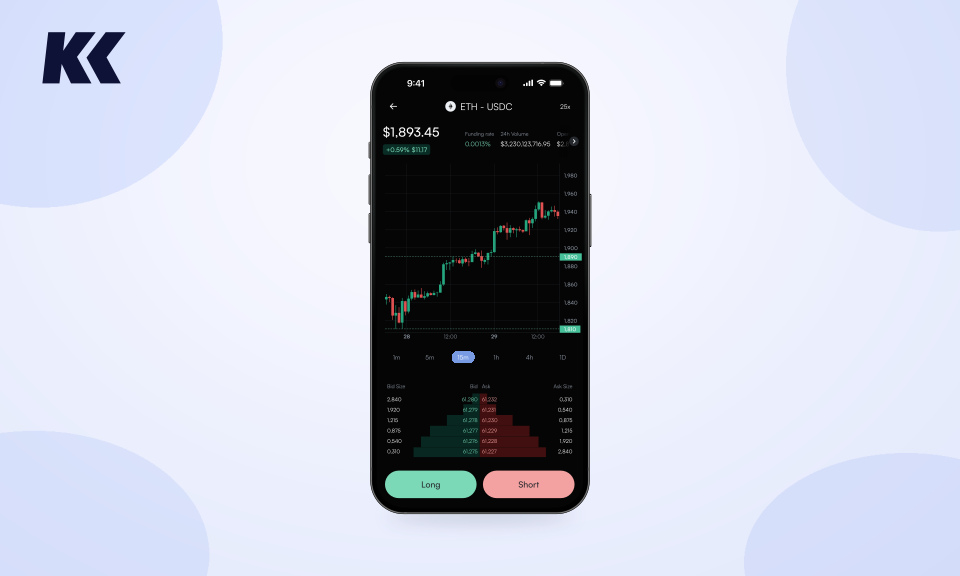
Several of this week's names trade as perpetuals on KriptoK, including BTC, HYPE, GOOGL and ICE. Our guide to perpetuals, funding and liquidation explains the contract mechanics, and our guide to using Hyperliquid on mobile with KriptoK explains the trading workflow.
Round 6, the final round of KriptoK League Season 1, is live. Follow the current leaderboard.
This recap is informational and is not a trading recommendation. Figures reflect the linked sources available on October 30, 2026, with market data as of 10:00 a.m. Eastern Time; source data may be revised.
Trade perps, swap tokens and compete in KriptoK League from one self-custody app.