
en
If you've only used crypto exchanges, you've been trusting someone else to hold your assets. Self-custody changes that. Here's what it means.
If you've only used crypto exchanges, you've been trusting someone else to hold your assets. Self-custody changes that. Here's what it means.
Self-custody means that you control the private keys used to authorize transactions instead of delegating that control to a custodian. This gives you direct control, while also making you responsible for protecting the keys and reviewing transactions.
Think of it like cash: A bank holds your money and can freeze your account. Cash in your wallet is yours to control. Self-custody is the "cash in your wallet" version for crypto.
When you buy crypto on an exchange:
This is called custodial storage - the exchange has custody of your assets.
With KriptoK’s self-custody platform:
Your crypto lives on the blockchain. Your wallet is the tool that lets you access it.
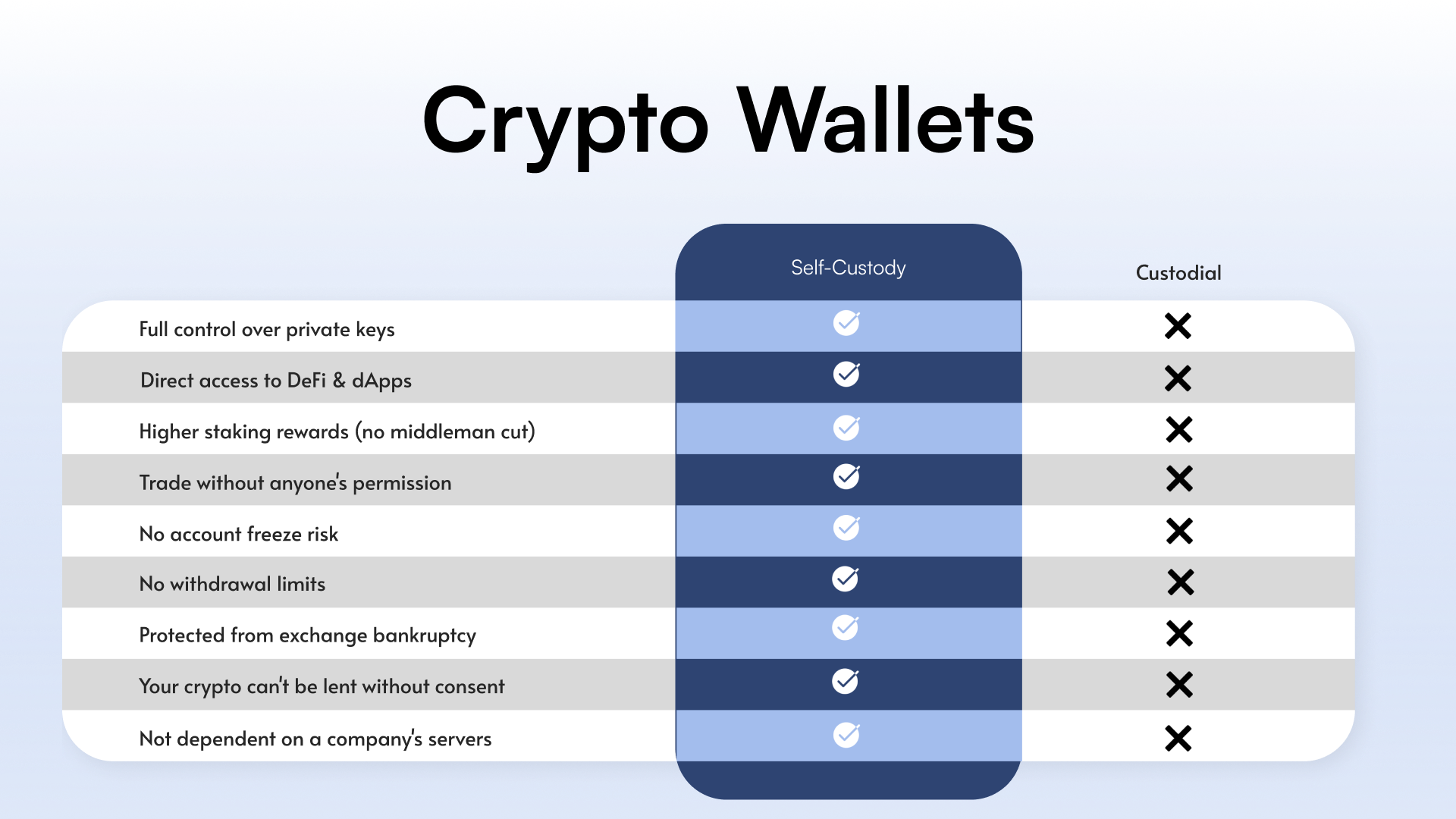
1. True Ownership
On an exchange, you see a balance but don't directly control the underlying crypto. With self-custody, you own the actual crypto on the blockchain.
2. No One Can Freeze Your Funds
Exchanges can restrict accounts or withdrawals for regulatory, security, technical, or insolvency-related reasons. Self-custody avoids dependence on an exchange for transaction approval, while introducing risks that the user must manage directly.
3. No Withdrawal Limits
Self-custody wallets do not impose custodian-set withdrawal limits. Network fees, protocol rules, liquidity, and application limits may still apply.
4. Reduced Custody Counterparty Risk
Self-custody removes the need for an exchange to hold the keys to your assets. It does not remove risks from compromised devices, phishing, malicious approvals, smart contracts, or blockchain networks.
5. Privacy
A self-custody wallet can be used without opening a custodial exchange account. Connected services, onramps, and third-party applications may still collect information under their own policies.
Self-custody gives you control, but it also means you're responsible for security.
What this means:
This isn't meant to be discouraging. It simply means that with ownership comes accountability. Many people find this trade-off worthwhile for the freedom and security it provides.