
en
How tokenized stocks, gold, and bonds are bringing Wall Street on-chain, and why it matters for everyday users.

Real-world assets, or RWAs, are traditional financial assets, stocks, bonds, commodities, real estate, that have been tokenized and brought on-chain. Instead of holding a share of Apple through a brokerage, you hold a tokenized version on the blockchain that represents the same underlying value.
The idea is simple: take assets people already understand and make them available in a wallet, tradable 24/7, accessible globally, and without the friction of traditional finance.
If you've ever wanted to buy NVIDIA stock at midnight, or own a fraction of a gold bar without dealing with a vault, RWAs make that possible.
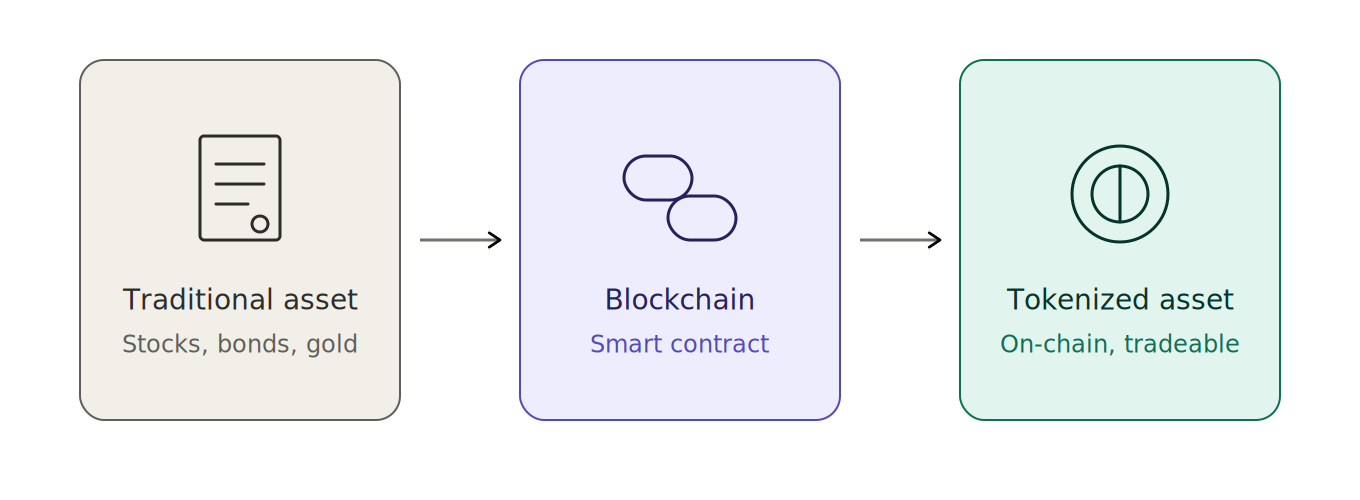
The tokenized asset market is expanding rapidly. According to recent projections, the RWA market could reach over $16 trillion by 2030. Institutional players like BlackRock and Franklin Templeton are already launching tokenized funds, signaling that this isn't a niche experiment, it's the future of finance.
Why the momentum? Because RWAs solve real problems:
24/7 trading. Stock markets close at 4 PM. Crypto markets don't. Tokenized stocks trade around the clock, so you can react to earnings reports or global news whenever they happen.
Fractional ownership. A single share of Berkshire Hathaway costs over $600,000. The tokenized version? You can buy $10 worth. RWAs make high-value assets accessible to anyone.
No intermediaries. Traditional stock trading involves brokerages, clearinghouses, and settlement delays. RWAs eliminate the middleman. You swap directly, settle instantly, and hold in your own wallet.
Global access. If you're in Turkey, accessing US stocks traditionally means opening an international brokerage account, dealing with currency conversions, and paying high fees. With RWAs, you just need a wallet.
The RWA ecosystem is diverse, covering most major asset classes:
Tokenized stocks. Companies you already know: NVIDIA, Apple, Microsoft, Tesla, MicroStrategy, Berkshire Hathaway. These tokens track the price of the underlying stock, giving you exposure without needing a brokerage.
Commodities. Gold is the most popular tokenized commodity, often used as a hedge during market volatility. Silver and oil are also available in some ecosystems.
Bonds. US Treasuries and corporate bonds have been tokenized, offering on-chain fixed-income exposure. This is particularly appealing to institutions looking for yield in a transparent, blockchain-based format.
Real estate. Property-backed tokens allow fractional ownership of real estate assets, though this is still an emerging category with regulatory complexities.
Stablecoins. Technically, stablecoins like USDC and USDT are RWAs, they're backed by real-world reserves (cash, Treasuries) and represent tokenized dollars.
The trend is clear: if it exists in traditional finance, someone is working on tokenizing it.
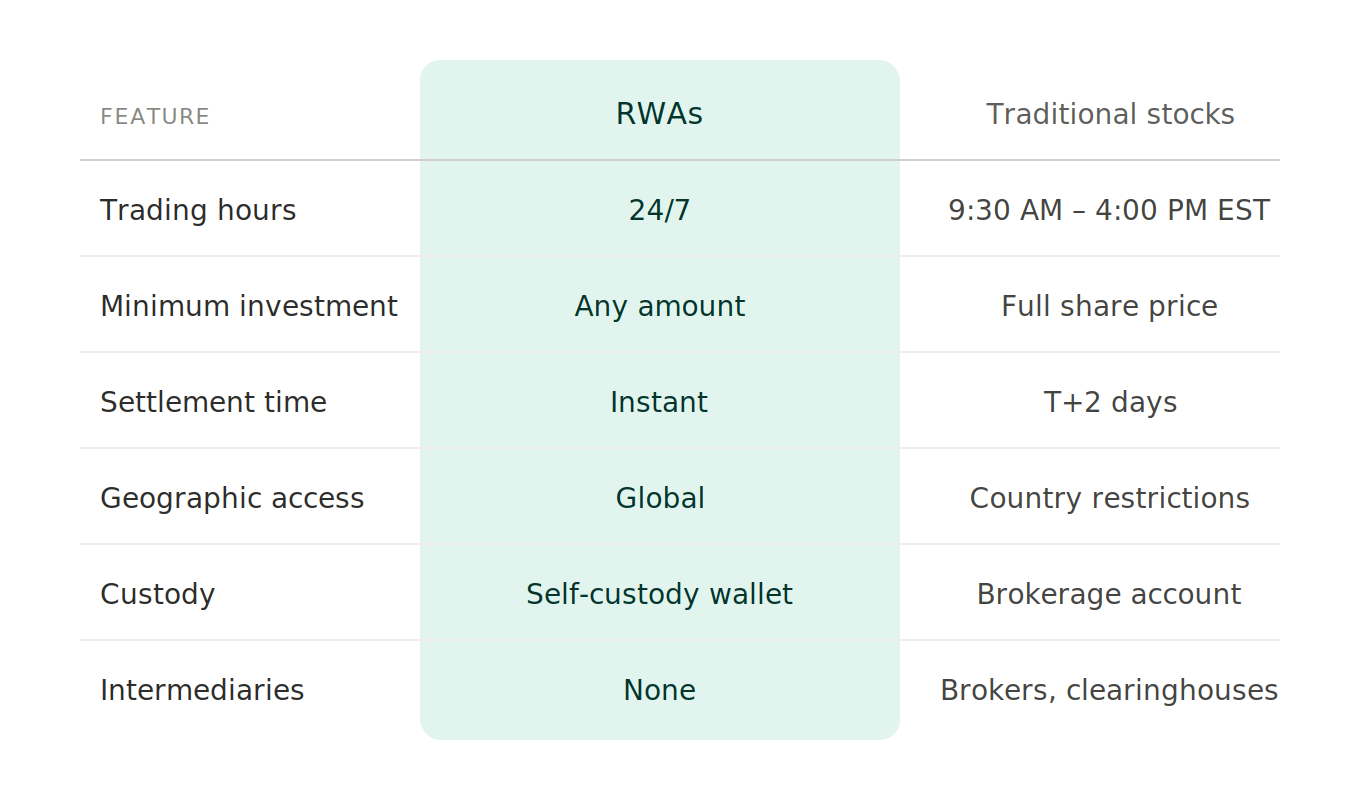
Let's break down the practical differences.
Trading hours. Traditional markets operate on fixed schedules. The New York Stock Exchange is open 9:30 AM to 4:00 PM Eastern Time, five days a week. If news breaks at 8 PM, you wait until the next trading day to react. Tokenized stocks trade 24/7. No waiting.
Minimum investment. Want to own Amazon stock? You need enough capital to buy at least one share (currently around $180). Want exposure to Berkshire Hathaway? That's over $600,000 per share. With tokenized versions, you can buy $5 worth. Fractional ownership removes the barrier.
Settlement. Traditional stock trades take two business days to settle (T+2). Tokenized assets settle instantly. You swap, you own it, you can move it or sell it immediately.
Geographic restrictions. Many brokerages restrict access based on residency. US stocks are harder to access if you're not a US resident. RWAs are borderless. If you have a wallet, you have access.
Custody. Traditional stocks sit in a brokerage account. You don't actually hold them, the brokerage does. Tokenized stocks sit in your wallet. You control the keys, you control the asset.
This isn't to say RWAs are strictly better in every case. Traditional brokerages offer investor protections, regulated environments, and insurance. RWAs trade convenience and accessibility for a different set of risks, which we'll cover later.
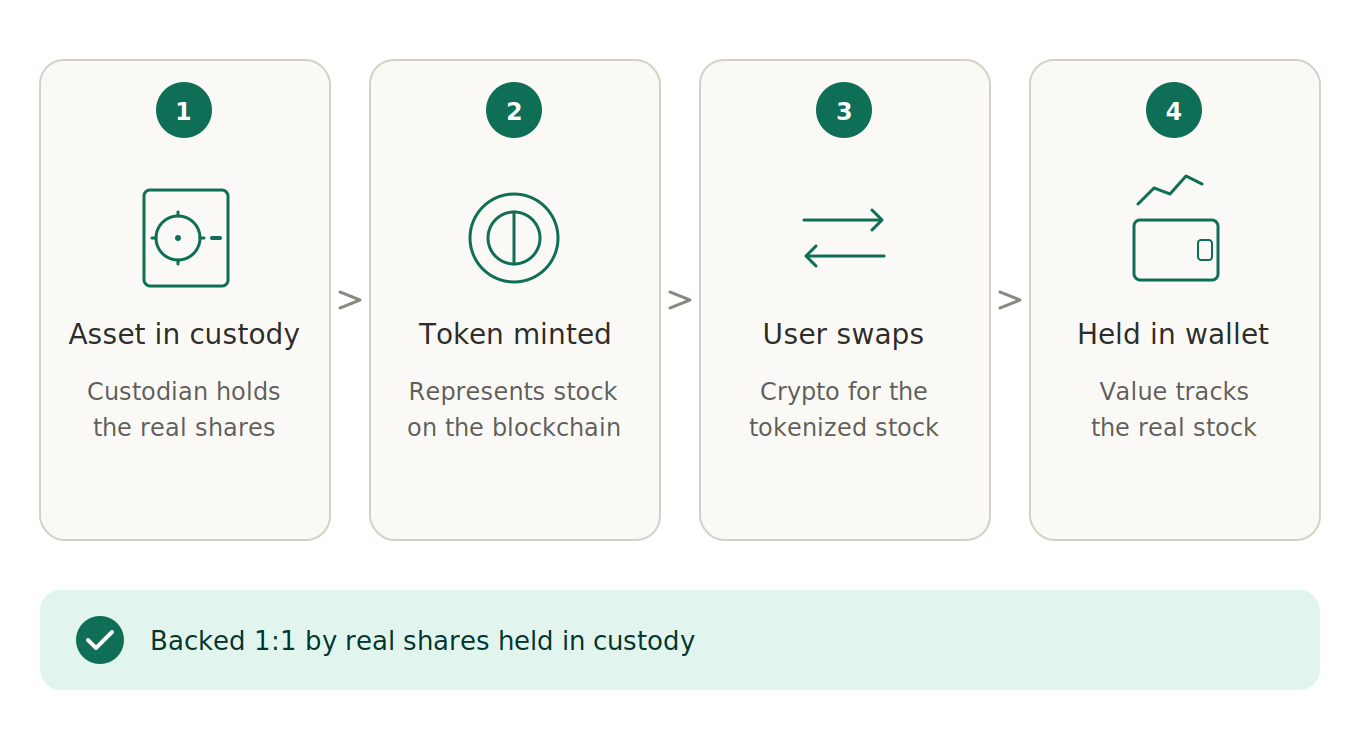
KriptoK makes accessing RWAs simple. You don't need a separate platform, a brokerage account, or a new onboarding process. Everything happens in the same wallet where you already manage your crypto.
Browse RWAs. Open the app, navigate to Browse, and you'll see tokenized stocks and commodities listed alongside tokens. NVIDIA, Apple, gold, all available in the same interface.
Swap directly. Want exposure to Microsoft? Swap SOL, USDC, or any supported asset into tokenized MSFT. The swap happens on-chain, settles instantly, and the tokenized stock sits in your portfolio.
Cross-chain support. RWAs are available across multiple chains within KriptoK, so you're not locked into one ecosystem. Swap on the chain that works best for you.
No extra steps. You're not redirected to a third-party platform. You're not setting up a new account. It's all in one place: your crypto, your tokenized stocks, your portfolio.
This is the core value proposition of RWAs on KriptoK: traditional assets, accessible in a crypto-native way, without the friction.
Diversification. Crypto portfolios can be volatile. RWAs let you hold exposure to traditional assets, stocks, bonds, gold, without leaving your wallet. You can build a balanced portfolio: 60% crypto, 30% tokenized stocks, 10% gold. All managed in one place.
Hedging. Market uncertainty? Hold tokenized gold. It's historically been a hedge against volatility, and now you can swap into it instantly without setting up a commodities account.
Global access. If you're based outside the US and want exposure to American stocks, RWAs remove the friction. No brokerage signup, no currency conversion fees, no geographic restrictions. Just swap and hold.
24/7 reactivity. Earnings report drops after hours? With tokenized stocks, you can act on it immediately. You're not waiting for the market to open.
Fractional ownership. You don't need $50,000 to build a diversified stock portfolio. With RWAs, you can allocate $100 across five different tokenized stocks and start building exposure at any scale.
These aren't theoretical. These are real reasons people are moving into RWAs.
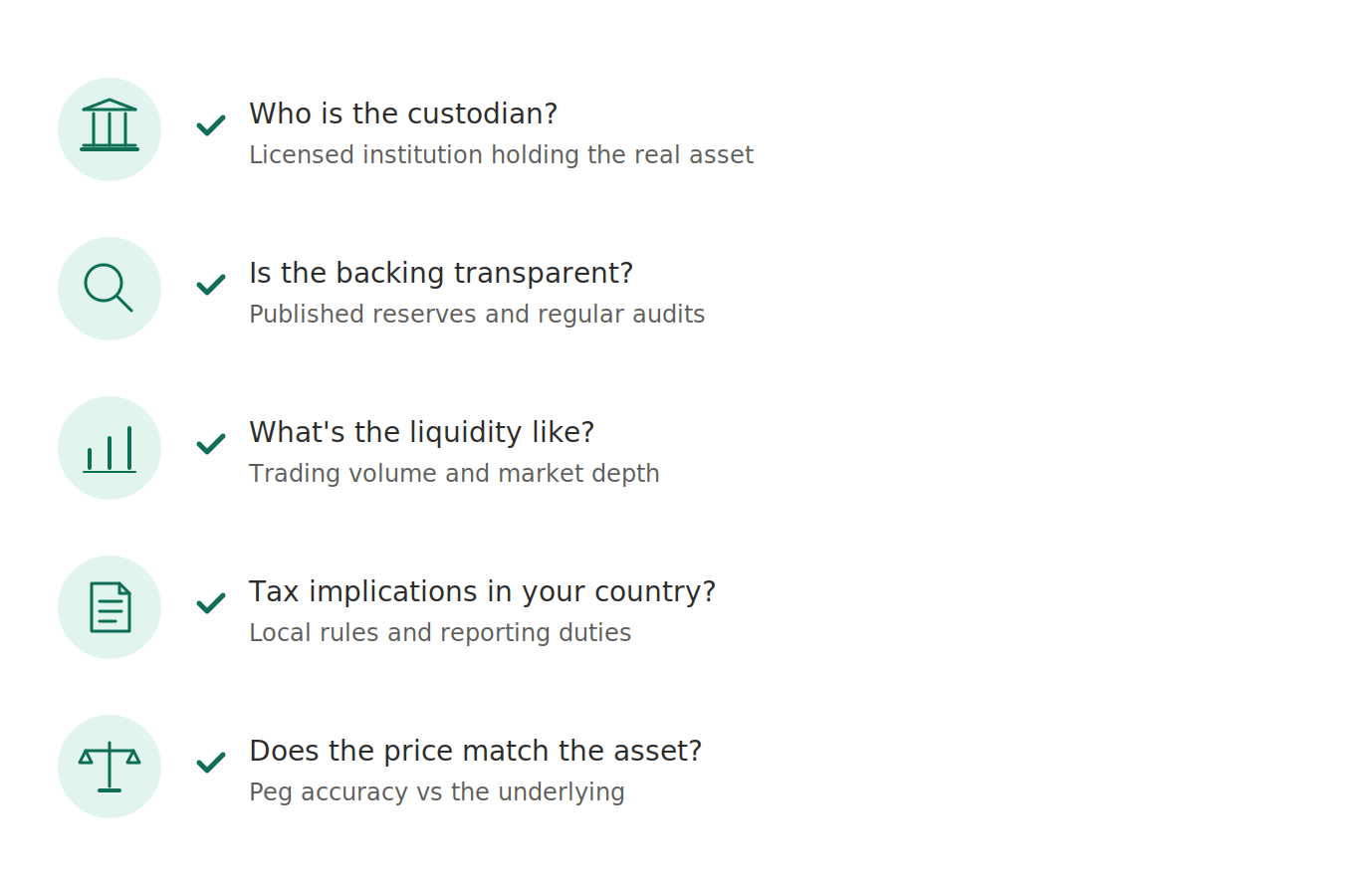
RWAs are promising, but they come with risks that need to be understood.
Regulatory uncertainty. Tokenized assets exist in a gray area in many jurisdictions. Regulations are still being written. What's allowed today might be restricted tomorrow. This is especially true for tokenized securities.
Counterparty risk. Most RWAs are backed by a custodian holding the real-world asset. If that custodian fails, or if the backing isn't transparent, the token loses value. Always check who's issuing the token and how it's backed.
Liquidity. Not all RWAs have deep liquidity. Some tokenized stocks trade with wide spreads or low volume, which can make entering and exiting positions more expensive.
Tax implications. Depending on your jurisdiction, holding tokenized stocks might be treated differently than holding real stocks for tax purposes. Consult a tax professional before making large moves.
Premium/discount to underlying asset. Tokenized assets don't always trade 1:1 with the real-world asset. Supply and demand dynamics on-chain can create premiums or discounts. A tokenized share of Apple might trade slightly above or below the actual stock price.
These risks don't disqualify RWAs, they just mean you should approach them with the same diligence you'd apply to any financial product.
The trajectory is clear: more assets are moving on-chain.
We're seeing banks launch tokenized deposit products. Asset managers are tokenizing mutual funds. Governments are exploring tokenized bonds. The infrastructure is being built, and adoption is accelerating.
RWAs represent a bridge. For traditional finance users, they're a way to access blockchain benefits, transparency, speed, global reach, without abandoning familiar assets. For crypto users, they're a way to diversify and hedge without leaving the ecosystem.
KriptoK's role in this shift is to make RWAs accessible. Not just for institutions or high-net-worth individuals, but for anyone who wants to hold a mix of crypto and traditional assets in one wallet, without needing five different platforms.
The future of finance isn't purely crypto, and it isn't purely traditional. It's hybrid. And RWAs are the connective tissue.
If you want to explore RWAs:
Step 1: Open KriptoK. If you don't have the app yet, download it and set up your wallet.
Step 2: Browse RWAs. Navigate to the Browse section and explore tokenized stocks, gold, and other real-world assets.
Step 3: Swap. Choose an RWA, swap into it using any supported asset (USDC, SOL, ETH, etc.), and it'll appear in your portfolio.
Step 4: Hold or trade. Your tokenized assets sit alongside your crypto. Track performance, swap between assets, or hold long-term.
It's that simple. No brokerage account. No extra platform. Just your wallet and the assets you want to hold.
RWAs aren't a replacement for traditional finance. They're an evolution. They take the assets people already understand, stocks, gold, bonds, and make them work in a blockchain-native environment.
For users, this means more control, more access, and fewer barriers. For the broader market, it means traditional finance and crypto are converging faster than most people realize.
KriptoK is built for this convergence. A wallet where your SOL, your tokenized NVIDIA shares, and your USDC all sit together. Where you can swap between them instantly, hold them in one place, and manage your full financial picture without needing three different platforms.
Real-world assets are here. And they're only getting started.